Wednesday, September 9, 2020

Pete Seeger, Selma, and Kenosha: Thoughts on Nonviolence and our Neighbors in Troubled Times

“I believe that in the period of history we are entering, it is going to be very difficult to love a large portion of the human race living here in the USA.”  -- Pete Seeger, June  6, 1965

I have spent the strange and terrible summer of 2020 alternately researching the life and work of songleader and folklorist Pete Seeger and standing with my Black Lives Matter sign on the corner of Main and Claremont. Seeger, the banjo picker and lifelong activist, has had a lot to say to me as trucks roar by and voices yell at the small band of Ashland’s persistent witnesses.

Around sixty days into the demonstrations, a nice old gentleman pulled up at the light, rolled down his window. “Thank you for not being like those violent protesters,” he said. He had obviously been watching the news filled with the late-night stand-offs in Portland: the tear gas, riot gear, umbrellas, fire and broken glass. He had also been listening to the political rhetoric designed to incite fear rather than offer insights to calm and heal.  But he had observed the motley collection of local people standing downtown and we didn’t match that reality: we hadn’t smashed, burned or looted anything.

His compliment struck us as absurd.

We are, indeed, a nonviolent protest but, honestly, what other option would we even have?  Certainly there are some of us who embrace Jesus’ ethic of loving enemies and refusing to strike back but others find that kind of talk naive and irritating. What unites us is our anger at the terrible life-destroying statistically undeniable bias in our country’s justice system. We have been heartened by the honks of support and look of joy and surprise on people’s faces as they drive past. We have also at times been shocked by some of the responses from our fellow Ashlanders, particularly when the screamed racist invective has been hurled at children. We all at times wonder if there is any purpose to what we are doing. One middle aged man on a Harley shook his head, “Jesus Christ! Give it up already.”

The week of the news from Kenosha followed by images of the counter-protest convoy of trucks flying “Trump 2020” and “Blue Lives Matter” flags pouring into Portland seemed very familiar to us. We see those same trucks every day--we jokingly call them the Ku Trucks Klan. But these are our neighbors who think we are terrorists and yell “All Lives Matter, dumbass!” at us as they pass. How on earth are our divided communities going to move forward? How much worse is this going to get?

In March, 1965, Pete Seeger and his wife Toshi walked alongside John Lewis on the march from Selma to Montgomery. Lewis was one of the great American apostles of nonviolence; for him nonviolence was a way of life. Seeger, took a more pragmatic approach. He, perhaps like most of us, was impressed and inspired by the nonviolence of the Student Nonviolent Coordinating Committee (SNNC) and the Southern Christian Leadership Conference (SCLC); however, he couldn’t completely give up the idea that a conflict might arise where violence would be the last resort needed to stop a terrible enemy.

Pete Seeger was excited to hear all the singing going on around him. A group of teenage girls walked behind the couple. For mile after mile they sang. They sang church songs and school songs and freedom songs hoisting up the songs like sails to catch the wind. Some filled and went on for chorus after chorus with voices up and down the line joining in. Others just flapped against the mast to be lowered after only a couple of verses. Seeger jotted down the words marveling at the way that the girls were singing new words to old songs and adding their own verses--seemingly making some of them up on the spot.

I love everybody, I love everybody, I love everybody in my heart

One of the new verses surprised the veteran folk singer.

I love Governor Wallace in my heart . . .

Governor George Wallace of Alabama, who had famously intoned, “I say segregation now, segregation tomorrow, segregation forever.”

For the communist Pete Seeger, this joyful moment of singing brought alive a piece of Christian teaching, “If any one says, ‘I love God,’ and hates his brother, he is a liar; for he who does not love his brother whom he has seen, cannot love God whom he has not seen” (1 John 4:20 RSV). It played over in his mind in the succeeding weeks. In June he gave the Baccalaureate address at a college. Telling the students about the march and the girls singing he said, “I’d like to commend this spirit to you, because I believe that in the period of history we are entering, it is going to be very difficult to love a large portion of the human race living here in the USA.”

Seeger was anticipating the escalating conflict and political polarization around the war in Vietnam and poverty at home: divisions that over the next few years brought riots to cities and death to college campuses and mass protests to the capital. But those words spoken 55 years ago never seemed more relevant than they do to me today.

They are honest words.

Today, many Americans find it increasingly hard, if not impossible, to understand the priorities and political commitments of their fellow Americans. Looking ahead, it will be hard for us to love each other after all that has been going on.

Pete Seeger, who was instrumental in bringing the song Kumbaya to the folk revival and the civil rights movement, did not offer those students what we might now call a Kumbaya moment at their graduation; instead, he issued a wake up call: “I believe the best thing you can do is make up your mind that you will be living in an unpleasant world for much of your lives.” But then drawing on his experience on Alabama’s Highway 80, he said, “If we are in for a struggle to keep our country from falling into bad ways, don’t think it need be a joyless struggle. Far from it. As Jesus urged his disciples, ‘Be of Good Cheer.’”

For me, these words have been incredibly helpful. I am not going to pretend (as we hear some say) that our problems will magically disappear after the elections in November. Whoever wins, we will be stuck for decades with the damage already done. These carefully nurtured divisions will continue to damage and destroy lives.  

How do we proceed into that future? I am with Pete Seeger and the Apostle John: the key question is how on earth are we to love our neighbors that we see everyday?

I appreciate Seeger’s honesty, loving some people is going to be a struggle.

Pete Seeger was not a Christian; his mother in-law used to jokingly chide him for his “diabolical materialism.” But maybe he understood Jesus’s words in John’s gospel better than many of us who profess to be his disciples. The words of Jesus that Seeger quoted to the students all those years ago come from John’s gospel: “In the world you have tribulation; but be of good cheer, I have overcome the world” (John 16:33).

I take heart today from the joy Seeger glimpsed on the march from Selma to Montgomery: he witnessed a nonviolent movement building and celebrating community and singing together. Perhaps only when the struggle is nonviolent can there be the hope that it will not be a joyless struggle.

--

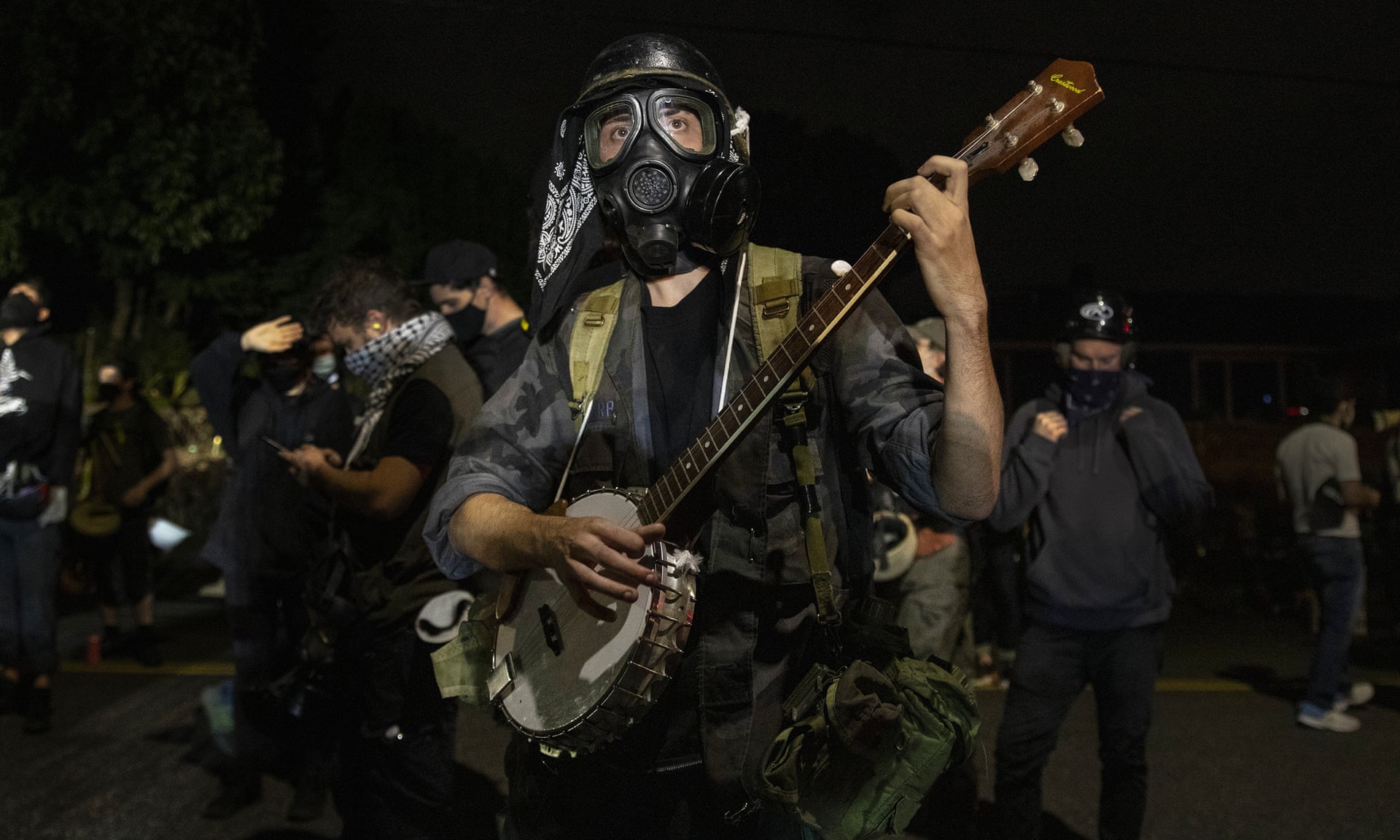
Photo: A protester plays a banjo during the nightly protests at a Portland police precinct on Sunday, 30 August 2020. The protest was declared an ‘unlawful gathering’ by Portland police. Photograph: Paula Bronstein/AP

This post was originally published by the Ashland Center for Nonviolence 

Monday, June 22, 2020

Prophets of Zoom

Historian Jemar Tisby was scheduled to speak at Ashland University in my class REL340 Religion and the Civil Rights Movement; that was until the Coronavirus cancelled all events and moved all classes online.

Tisby, author of The Color of Compromise: The Truth about the American Church’s Complicity in Racism, kindly agreed to speak to the class on Zoom.

It went so well that it occured to me that there were other people I would love my students to meet and learn from.. I invited Rev. Michelle Higgins, the founder of Faith for Justice in St. Louis, and Rev Seth Wispelwey, one of the organizers of Congregate Charlottesville. Both kindly agreed to show up.

Recordings of the classes are available for anyone to watch -- click on the titles to go to the videos (I apologize for my rudimentary Zoom skills):

1. Reconsidering Racial Reconciliation - A Conversation with Jemar Tisby


2. Six Years Since Ferguson - A Conversation with Michelle Higgins


3.  . . . since Charlottesville - A Conversation with Seth Wispelwey


Friday, March 8, 2019

Witness Podcasts

Co-editor of Can I Get a Witness has done a fantastic job of interviewing the authors and putting them together as a podcast series.
Here is the episode on my historical character, Howard Kester:


You can find all the other episodes on Stitcher (playable from the webpage) or on iTunes as well as the other usual podcast places.


Thursday, February 28, 2019

Can I Get a Witness?

I have contributed a chapter to the book Can I Get a Witness?: Thirteen Peacemakers, Community-Builders, and Agitators for Faith and Justice, just published by Eerdman’s. . . and there are lots of pictures!

The book--as the blurb will tell you--presents “the compelling stories of pioneers for social justice who engaged in peaceful protest and gave voice to the marginalized, working courageously out of their religious convictions to transform American culture,”

I had the wonderful experience of working with twelve other writers brought together by the Project on Lived Theology. We are trying to present a range of very human Christian heroes from the last century -- some familiar and some you’ll have never heard of -- that will prompt us to be witnesses today. I think we have succeeded: the book is by turn challenging and inspiring.

My chapter is on the fascinating but little-known American prophet Howard Kester. It focuses on the period in the 1930s when Kester, a white man and a southerner, risked his life going undercover to investigate lynchings and peonage. Kester had a huge influence on a generation of Christian students through his writing and speaking, which helped lay the groundwork for the civil rights movement.
Historians credit his courageous work with making a decisive contribution to the ending of spectacle lynching in the United States.  I found him intriguing because he really struggled to bring together the power of a personal faith and a bold witness to social justice

I had the wonderful experience of working with twelve other writers brought together by the Project on Lived Theology. We are trying to present a range of very human Christian heroes from the last century--some familiar and some you’ll never have heard of. I am very proud of the end result which is, in large measure, due to the herculean editing efforts of Shea Tuttle.

Podcasts
There is a set of podcasts--interviews with each of the author's--to accompany the release of the book. You can find all the other episodes on Stitcher or you can search for "Can I Get a Witness?" in the usual podcast places (iTunes, Podcast Addict, etc.).

Lenten Reading Guide and Conversation
And as if that isn't enough to get you to engage with these stories, there is a Lenten reading guide and discussion online starting on Ash Wednesday -- join the discussion group on Facebook.
____

Here is a list of the contributors and the characters:

Daniel P. Rhodes on Cesar Chavez
Donyelle McCray on Howard Thurman
Grace Y. Kao on Yuri Kochiyama
Peter Slade on Howard Kester
Nichole M. Flores on Ella Baker
Carlene Bauer on Dorothy Day
Heather A. Warren on John A. Ryan
Becca Stevens on Frank William Stringfellow
W. Ralph Eubanks on Mahalia Jackson
Susan M. Glisson and Charles H. Tucker on Lucy Randolph Mason
Soong-Chan Rah on Richard Twiss
David Dark on Daniel Berrigan
M. Therese Lysaught on Mary Stella Simpson

Thursday, January 24, 2019

MLK Day Speaker at First Baptist Church, Dover, OH

On Jan 21, I was honored to give the address at the First Baptist Church in Dover, Ohio for their annual Martin Luther King Day Celebration. First Baptist is a historic African American congregation. After the service, the older church members shared their stories with me and my family of life in "Tin Town" between the wars.

The local newspaper covered the event and included a fair summary of my talk and some extensive (and well punctuated) quotations.

“If we dream dreams like King for righteousness and justice in our world, then we are in fact praying. And God’s justice and righteousness isn’t something that we dream on and pray for, it’s something we do.”

“Dr. King’s dream for reconciliation, peace and justice in this country is still a prayer yet to be fully answered, but it’s a prayer that challenges us not to be just dreamers one night a year, not just something we include in status updates. No, that prayer challenges us to put our feet on the path of God’s righteousness to do right by our neighbors.”

Tuesday, November 20, 2018

Howard Kester and Martin Luther King Jr.

The Journal of Southern Religion has published my article "A Misplaced Hope: Howard Kester, the Fellowship of Southern Churchmen, and the Failed Attempt to Mobilize White Moderate Protestants in Support of Desegregation, 1952-1957."
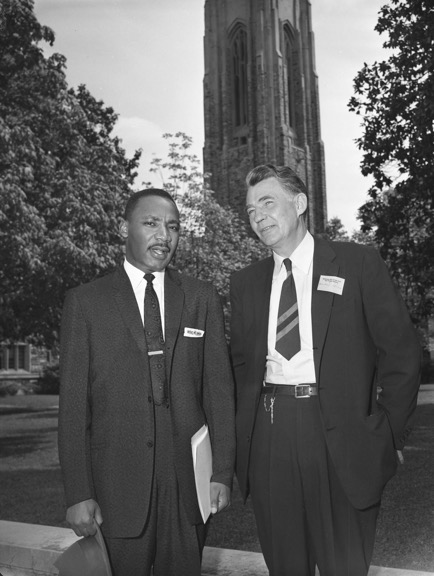
Martin Luther King Jr. and Howard Kester at 
the Conference on Christian Faith and Human  
Relations, Scarritt College, Nashville, April 25, 
1957. Photographer: Jack Gunter, courtesy 
Nashville Public Library, Special Collections.

If you would like a printable version then here you go.

In the article, I look at the failed attempt by some remarkable southern Christians in the 1950s to mobilize white moderate Protestants in support of desegregation. It is really my response as a church historian to this 'Trump moment' in the American church.

It is the by-product of the research I did into the life and work of Howard Kester for a chapter in the upcoming book Can I Get a Witness? Thirteen Peacemakers, Community-Builders, and Agitators for Faith and Justice.

Tuesday, June 12, 2018

Thoughts After Reading Mitch Landrieu’s In the Shadow of Statues: A White Southerner Confronts History


I have written a review of Mitch Landrieu's book over on the Project for Lived theology's web site. It is really my reflection how hard it is for even the supposedly most "woke" white people to really come to terms with the power and persistence of white supremacy.

Thursday, April 26, 2018

The Massive Resistance Museum and the Other Local People

Over spring break I went on a 2,000 mile road trip to Jackson, Mississippi to see the state’s new civil rights museum. As historian Jemar Tisby explained when the museum opened back in December, the philosophy behind the exhibits is influenced by John Dittmer’s 1994 book Local People: The Struggle for Civil Rights in Mississippi. The Mississippi Civil Rights Museum does not settle for expanding the pantheon of civil rights heroes (Martin Luther King, John Lewis etc) with new ones (Fannie Lou Hamer, Medgar Evers etc.). Instead, the museum presents an overwhelming array of names and photographs of the army of local people who:
  registered to vote,
  rode greyhound busses,
  boycotted businesses,
  prayed in churches,
  integrated schools,
  ate at lunch counters,
  and went to jail.

Overwhelming, at least, for those who prefer their history neat and contained and bounded. These exhibits, and the history they reveal, defy any individual’s encyclopedic knowledge. This is a good thing. As the museum’s advisors and designers no doubt intended, a visitor leaves with a sense of the massive, messy, movement of local people that over decades challenged the forces of white supremacy that enslaved, disenfranchised, and oppressed African Americans in Mississippi and America: a movement of local people that continues to the present and that you--a visitor to the museum--can choose to join.

White supremacy, of course, is not a disembodied force: it took white supremacists to make it work. It took hundreds of thousands of “local people” too--far more, in fact, than the local people demanding civil rights. This is a reality that the Mississippi Civil Rights Museum does not communicate as successfully. It does not, in my opinion, succeed in giving the visitor an equivalent sense of this massive, messy and continuing movement of local people.

Don’t misunderstand me, the museum does not sugarcoat or minimize the crimes of white supremacists:
  lynchings,
  bombings,
  assassinations,
  beatings,
  economic exploitation,
  school segregation.
But it only gestures toward the armies of local people behind these crimes using Klan robes, burnt crosses and the names and photographs of the usual villains (Sam Bowers, Cecil Price, Edgar Ray Killen, Ross Barnett).

The thousands of Mississippi’s schoolchildren passing through the museum really need to understand this other movement of local people.

To appreciate the forces preventing this, just engage in this thought experiment. Imagine the announcement of a new museum: The Mississippi Massive Resistance Museum. It is a museum that tells the long story of white supremacy and massive resistance stretching from the earliest days of European settlement to the present day. It presents the range of people who profited from white supremacy and the lengths regular people went to to maintain their race-based privilege. The museum helps visitors understand how white supremacy required tens of thousands of local people to support and maintain it.

Imagine, one display tells the story of the trial of Roy Bryant and his half-brother J.W. Milam--the self-confessed murderers of the young Emmett Till in 1955. Bryant and Milam’s photographs are there of course, just as they are in the civil rights museum; but in this imaginary Massive Resistance Museum, so too are the photographs and names of the white men on the grand jury who refused to indict them.
Another display contains the names and photographs of law enforcement officers known to have been in the Klan. A whole wall has the names and photographs of the directors of the state’s chapters of the Citizens’ Council. These lists of names are available in the state’s secret police files. Looking at the photographs of the directors of Jackson’s chapter, visitors will see the city’s white attorneys, civil servants, doctors, and business owners.

White children will see their grandparents.

You get the idea.

Can you imagine such a museum actually being built in Mississippi or any other state in the union?

I can’t.

I am afraid I can’t imagine this level of truth-telling:
the kind of truth-telling we need as a country so that we are not constantly surprised by the irruptions of hate and violence;
the kind of truth-telling we need as a country so that we are not blindsided by the unidentified but often felt influence of white supremacy in the lives of local people.
I can’t imagine it.
But then I couldn’t have imagined the opening of a national museum taking a hard look at the history of lynching either . . . and that happened today. So what do I know?

Thursday, April 5, 2018

Sermon on the Anniversary of MLK's Assassination

I delivered a sermon, "Prayer and Justice", at the community chapel service in Ashland University's Chapel on April 4 to mark the 50th anniversary of Martin Luther King's assassination.


I wove together the story of King's last year and the Poor People's Campaign with James 5:
"Listen! The wages of the laborers who mowed your fields, which you kept back by fraud, cry out, and the cries of the harvesters have reached the ears of the Lord of hosts. . . You have condemned and murdered the righteous one, who does not resist you."

But America chose not to listen​;
instead​,​ the majority--the friends of the world--chose to condemn King and, in so doing, were complicit in his murder.
In many ways, what we see today on our streets and in our government,
in the news and on our smartphones:
the unrest, the divisions, the racism,
the economic disparities between the haves and the have nots,
the violence, and the murder
--the fact that 50 years after King’s death we still need to remind ourselves that Black Lives Matter too--
in many ways, all of this is the consequence of our country’s condemnation of King and the rejection of his message.
-
For further reading:
Here are links to the the document and sermons I reference in the sermon:

Friday, July 8, 2016

Baton Rouge, St Paul, Dallas

To all of you who were students in the Civil Rights and Religion Class,

I wanted to write to you this morning as the news following the killing of Alton Sterling in Baton Rouge, Philando Castile in St Paul and four police officers in Dallas.

I want to share with you my grief and horror over these events.

We spent the Spring semester studying the recent history of race in America . As a result, we have done some important work that should help us have a nuanced understanding of the way these events unfold and in particular, the way different people react to news stories of white police officers killing black men and snipers targeting police officers.

Because of our studies, I believe that we are particularly responsible to be salt and light in the days ahead.

Three verses of scripture come to my mind:

Blessed are they that mourn: for they shall be comforted.
There are people mourning the death of children, husbands, and fathers today. There are communities filled with grief. We need to stand with them, pray with them and bring them comfort.
Blessed are they which do hunger and thirst after righteousness: for they shall be filled.
We understand the context in which these terrible events are playing out -- we should be alongside those crying out for people to do the right thing: to work for justice. Over the coming days and weeks you will hear people offer all kinds of simplistic explanations and solutions. Remember all we learned about the nature of our racialized society -- remember there are bad apples, bad barrels and bad barrel makers. You have an obligation and opportunity to bring sanity and insight into these conversations
Blessed are the peacemakers: for they shall be called the children of God.
I am deeply concerned by the potential that these events have to lead to more anger, violence and hatred. As we work for justice I pray that we would be peacemakers of a lasting peace.

I am proud of you all and the work we did together,
Peter

Wednesday, August 5, 2015

Signs of the Crimes and the Forgiving Victim


On Sunday, August 2, 2015, I attended the 10am service followed by the "Prayerful Conversation" at St Paul's Episcopal Church in Richmond, Virginia. This isn't just any church. Built in 1845 right next to the capitol building it earned itself the title of "Cathedral of the Confederacy." The fittings and fixtures in the sanctuary proclaim this fact. It was the church of Robert E. Lee and of Jefferson Davis and their pews are marked with brass plaques. The walls and windows bear their memorials.

Five weeks earlier, on Sunday, June 28, following the shootings at Mother Emanuel in Charleston SC, Rev. Wallace Adams-Riley, the priest at St Paul's, questioned his congregation from the pulpit:
What if in this the last summer of the Sesquicentennial of the American Civil War, we begin a conversation here at St. Paul’s about the Confederate symbols here in our worship space?
Adams-Riley contacted a fascinating organization Justice and Sustainability Associates (JSA) to facilitate this discussion at St Paul's. On August 2, Adams-Riley stood at the front of the church.

"The question before us this morning is one of discernment. . .  Given our mission, we need to discern what would God have us do about the Confederate memorials and symbols?"

He was followed to the lectern by JSA's CEO Don Edwards who, in a gentle voice, laid out the ground rules for the small group discussion that was about to happen. The congregation then split into 11 groups  (each had a facilitator and a scribe) and shared their feelings about the monuments and their understanding of the mission of the church. This is an ongoing conversation and I was an observer on the understanding that I would not share the content of the discussion. I will say that the spirit of openness was remarkable. Participants seemed relieved and perhaps surprised that they could have this conversation.

When we gathered back in the sanctuary, the reports from the groups were encouraging and included creative suggestions for the sanctuary as well as a concern for the future ministry of the church. Many noted with concern the complete absence of any memorials to, or mentions of, slavery -- not even to the enslaved people who must have built the church.  It was evident too that this conversation was only in its early stages with a lot of work still lying ahead.

Don Edwards encouraged the congregation. "We can all be winners in this process."

It will be fascinating to see how this congregation comes together to address these issues, in part because they have such an extreme case of Confederate imagery, but also because they are such an unusual congregation:
  • This is a highly educated congregation: I wouldn't like to hazard a guess at the number of advanced degrees per member, but I suspect it is absurdly high.
  • It has a history of being a politically powerful congregation: the members consider themselves to have a tradition of being "involved in the community." I understood them to mean that they had influenced the politics of the city of Richmond as well as been involved in the more standard social ministries.
  • It is a politically progressive and theologically liberal congregation: The famously theologically liberal Jack Spong was the rector from 1969-1976 and many of the folks in my group dated their involvement in the church from his tenure. They told the story of Spong removing the Confederate flag from the church's portico. Today the church is proud to welcome same-sex couples and celebrate their marriages.
  • The congregation is racially integrated: This is a historically white congregation but I observed somewhere between 5-10% of the participants in the Conversation that morning were African American and one of the three priests is African American.
  • The church is wealthy: It owns the city block on which it stands in the heart of Richmond and, I was told, it has a very impressive endowment. The endowment is so healthy that pretty much anything they decide to do, they can do.
To help facilitate the conversation, the church had produced an illustrated catalog of everything in the church that explicitly mentioned the Confederacy. In the discussions I heard, everyone saw these as a collection of individual objects. They were understood as memorials placed by family members--faithful members of the congregation--to deceased loved ones.

I did not hear anyone consider what theological significance these memorials have today when they are gathered together in a sanctuary. More specifically, I did not hear anyone try and understand what theological messages those loving people who put these memorials in place intended to communicate to those who came after them to sit in the pews of St Paul's.

I have spent the last eighteen years of my life studying and writing about the history and theology of white churches in the American South. I teach courses on religion and the civil rights movement and on theologies of reconciliation. I want to share with you what the sanctuary of St. Paul's in Richmond preached to me that Sunday morning.

I feel a little bit like a character from a Dan Brown novel--a 'symbologist' from Ashland University. But let me 'decode' the theological messages on the walls of St. Paul's and describe what was for me an intense and disturbing experience.
_____

I walked into the sanctuary. "Where shall we sit?" asked my eight-year-old son.

"Easy," I say. "Let's sit here. If this pew was good enough for Jefferson Davis, it is good enough for us."

The red-cushioned pew is set in the middle of the sanctuary on the aisle. This places me exactly between the Jefferson Davis memorials and windows on my right and the Robert E. Lee memorial and windows on my left.

It is the familiar Episcopal service: prayers, hymns, readings.

As the sermon begins, I feel a growing pressure on my thoughts. My mind is not wandering -- it is a good sermon-- instead, it feels like it is being focused, it is being squeezed by a vise-like pressure.

On my left is the beautiful Lee memorial window. It depicts Moses leaving the court of Pharaoh. As the church's own walking tour pamphlet explains, "The subject matter of this window refers to Lee's decision to refuse command of the Union forces and to ally himself with the Confederacy."
"Moses Leaving the Court of Pharaoh" Holiday 1892

I am very familiar with the white Southern valorizing of the leaders of the Confederacy in the decades following the Civil War.  My former professor Charles Reagan Wilson explains in his classic work Baptized in Blood: The Religion of the Lost Cause, 1865-1920 how white southerners "portrayed Robert E. Lee, Stonewall Jackson, and Jefferson Davis . . . as saints and martyrs. They were epitomized as the best of Christian and Southern values." (25). Here in St. Paul's is the most intense example of this that I have ever seen.

The theological message comes pouring out of the window.

Lee = Moses

But in what way is Lee like Moses?

Detail,"Moses Leaving the Court of Pharaoh," Holiday, 1892
In the bottom right corner of the window is an edited text from Hebrews 11:24-27. Here is the passage in full:
24 By faith Moses, when he was come to years, refused to be called the son of Pharaoh's daughter; 25 Choosing rather to suffer affliction with the people of God, than to enjoy the pleasures of sin for a season; 26 Esteeming the reproach of Christ greater riches than the treasures in Egypt: for he had respect unto the recompence of the reward. 27 By faith he forsook Egypt, not fearing the wrath of the king: for he endured, as seeing him who is invisible.
Lee is Moses because he feared God and chose "affliction" and "the reproach of Christ" (persecution for the sake of Christ), and the "wrath of the king" rather than side with the Pharaoh/President of the United States.

In the window, Moses is looking off to his left. At his eye level is a brass shield. A memorial to Robert E. Lee. The theological connection with the window is explicit. On the Crusader's shield bearing the St. George's cross--St. George being the epitome of the Christian knight battling the dragon (Satan)--are the words:
"To the Glory of God and in grateful memory of Robert Edwd. Lee. Commander of the Army of Northern Virginia and Christ's Faithful soldier and servant unto his life's end"
Lee's loyalty to Virginia in its secession from the Union to defend the peculiar institution of slavery was the will of Christ. The war he helped prosecute--the waste of 750,000 lives, the devastation of the region--this was his Christian duty. Jesus was commanding Lee to fight for the right of Virginians to enslave Africans.

The theology keeps streaming out of the window. If Lee is Moses, then who are the Hebrews he is commanded by God to lead?  The answer is obvious.

The Confederacy = Israel

This is a most blasphemous claim but it is being proclaimed here in the sanctuary of St. Paul's. It is all around me. Right there in the window it states that Lee/Moses chose "to suffer affliction with the Children of God"

But it is the children of Abraham, the Israelites, the Jews, who are the true "Children of God"! They are the ones with whom God has made an everlasting covenant (Gen17:7). We, the Gentile followers of the Jewish Messiah, believe that through God's grace we have been adopted into this family covenant (Gal 4:5) and grafted into the vine of Israel (Rom 11:17).

Recent scholarship has shown how European Christianity misappropriated this covenant. They believed that God forsook the Jews for the crime of killing his son and made a new covenant with the Christian church. Not only did this lead to nearly two thousand years of genocidal antisemitism, it was how white Christians came to understand their right to steal land in the "new world." How we came to categorize, kill, displace, enslave, and relocate darker skinned people. Willie Jennings's devastating book The Christian Imagination: Theology and the Origins of Race, shows how this heresy of supersessionism -- the failure of the European church to realize they are Gentiles, instead claiming to have superseded the Jews as the covenant people of God -- led to the modern construction of race and the terrible crimes of colonialism, slavery and white supremacy.

And here is the proof of Jennings's tragic thesis beautifully presented in the stained glass all around me! God has made a covenant with White Southerners the glass proclaims. This theological crime, according to Wilson in Baptized in Blood, was a common theme in southern postbellum theology. He quotes the opening of a prayer from a veterans' gathering, "God of Israel, God of the centuries, God of our forefathers, God of Jefferson Davis and Sidney Johnston and Robert E. Lee and Stonewall Jackson, God of the Southern Confederacy." (33)

"Moses on Mount Nebo," Henry Holiday, 1892
This alignment of the white southern cause with Israel continues in the second memorial window to Lee directly above the first. It is called "Moses on Mount Nebo." The pamphlet explains, "Moses is shown as an old man with a beard, resembling Lee's appearance at the close of the Civil War. The children of Israel are depicted as a  sea of faces in the lower portion of the window." The catalog adds some more detail from the book Windows of Grace, A Tribute of Love (2004): “This is where God allowed Moses to view the Promised Land shortly before he died."

The account of Moses on Mount Nebo is in Deuteronomy 34.
1 And Moses went up from the plains of Moab unto the mountain of Nebo, to the top of Pisgah, that is over against Jericho. And the Lord shewed him all the land . . .
And the Lord said unto him, This is the land which I sware unto Abraham, unto Isaac, and unto Jacob, saying, I will give it unto thy seed: I have caused thee to see it with thine eyes, but thou shalt not go over thither.
Here we have the covenant promise to possess the land being made to the White South/Israel but Lee/Moses won't live to see it: Lee died in 1870  before the end of Reconstruction.

At this point it is important to pay attention to when these windows were put in the sanctuary. They were installed in 1892. This is the time that southern states are passing Jim Crow laws to disenfranchise and legally segregate African Americans and to establish the caste system of White Supremacy. Is this apartheid South the promised land that Lee fought for but did not live to see?

There is a story currently in circulation at St. Paul's of an incident in 1865 when an African American, breaking with the immutable racial conventions of the racial caste system, went forward to receive communion at the altar rail. The shocked congregation stayed in their pews. Breaking the impasse, Robert E. Lee went up to the altar rail and knelt down near the trespasser of sacred white sacramental space. This "eyewitness" story that started circulating the decade after the windows were installed was not originally told as an example of Christian reconciliation--far from it. Here is how the story originally concluded:
This lofty conception of duty by Gen. Lee under such provoking and irritating circumstances had a magic effect upon the other communicants (including the writer), who went forward to the communion table.
By this action of Gen. Lee the services were conducted as if the negro had not been present. It was a grand exhibition of superiority shown by a true Christian and great soldier under the most trying and offensive circumstances.

This story was an inspiring example of Lee maintaining the peaceful dignity of white supremacy.  An unyielding genteel Christian Virginian white supremacy: this is the cause celebrated in these windows from the 1890s. This is the promised land their parents fought for in the Civil War and that is yet to be fully attained.

"Paul before Herod Agrippa," Tiffany 1898
I turn and pay attention to Jefferson Davis's memorial windows on the other side of the church. These are some of the Tiffany windows in the church. The Davis memorial windows were installed in 1898. The lower one titled "Paul before Herod Agrippa" is exegeted in the pamphlet:
This biblical event alludes to Confederate President Davis's own two year imprisonment following the Civil War, which most Southerners felt was unjust.
With the idea of the Southern Confederacy as the covenant people of God ringing through my mind, this window has new significance.

Paul's fateful audience with Herod Agrippa is in Acts. His opening words to his judge lay out his impeccable Jewish credentials and then he invokes the covenant, "Now I stand and am judged for the hope of the promise made of God, unto our fathers" (26:6).


"The Angels of Goodness and Mercy," Tiffany, 1898
Jefferson Davis = St. Paul

Paul is "an Hebrew of the Hebrews" (Phil 3:5) whose only crime is to proclaim God's covenant fulfilled in Christ.  Davis is the confederate of confederates whose crime is to stand by the twisted notion of a God-ordained Anglo-Saxon civilization whose livelihood and survival is rooted in white supremacy.

The angels of goodness and mercy look down from the higher window upon the fettered Paul/Davis.  Beneath their feet are Job's words: "Let me be weighed in an even balance that God may know mine integrity" (Job 31:6).

Though Jefferson Davis and the South suffered like Job following the war -- the loss of children, health, and prosperity--it is not the Federal courts, the carpetbaggers, and scalawags who will ultimately judge the righteousness of Jefferson Davis's cause: it is God. And just as God eventually richly rewarded Job for his faithfulness through adversity, so too will God reward the white South for its faithfulness, even through defeat.

So the two upper windows, "Moses on Mount Nebo" and  "The Angels of Goodness and Mercy", both promise a restoration of the South and God's vindication of its cause.

____

The problem I am having is that I am not putting all these pieces together as an academic exercise at my desk. This is all crowding into my mind while I am participating in a worship service.

By now the sermon is long over and the priest is halfway through the Eucharistic prayer. My focus snaps to the front. To the altar. To the bread and the wine. I want to pull myself away from this evil theology of white supremacy.

Above the altar is King Jesus. But this Jesus does not throw me a lifeline. He is a white and oddly effete king. He is the genteel Virginian Jesus. He looks like one of the powerful friends of Jefferson Davis and Robert E. Lee. He stands there offering a blessing over this temple of the Lost Cause. "My peace I give unto you."

Unlike the Nazarene Jesus who promises a powerful peace "not as the world giveth"(Jn 14:27), the peace this Jesus offers me seems all too much of the world of Tiffany glass and white hegemony. This Jesus does not challenge the violence and slavery and segregation and racism celebrated on the walls and windows of the sanctuary.

As I begin to wonder whether I can go forward to the communion rail to receive the Eucharist in this place, my mind starts re-imagining the window.

King Jesus's skin starts to change color.

In my minds-eye, he is now black.

He has broken chains still hanging from his wrists.

This risen Jesus--our judge and king--was one of the hundreds of thousands of enslaved people sold in Richmond's slave markets. This Jesus was despised and rejected and exploited by those who built this church and raised its memorials. By his sweat and blood and wounds the slavocracy of Virginia made a massive profit and yet here he is in the Cathedral of the Confederacy not seeking revenge but inviting us to come to his table and to receive life.

He is extending his wounded hands beckoning me forward.

This is Jesus the forgiving victim--our victim--who extends peace: the Jesus risen from the dead who confronts those who abandoned him with the words "Peace be unto you" (Jn 20:19).

To be confronted by our victim--one I have victimized--is a hard thing.

It is a hard thing to step forward from the nave where I am surrounded by the religion of power and exploitation, where we are dead in our trespasses. To take those steps towards our victim who offers us forgiveness requires us to confess that we have sinned against him in "thought and word and deed, through negligence, through weakness, through our own deliberate fault."

Yet it is only the Jesus who became a slave, the Jesus who confronts us as our forgiving victim, who can save us.

By his blood [we shed], he reconciled us.
By his wounds [we inflicted], we are healed.


It is this Jesus who works the true miracle of the Eucharist this Sunday morning. Descendants of enslavers and enslaved go together to the table to become one body because we all share in one bread.

--
Note: This blog was originally posted on August 5, 2015. It was taken down later that same day at the request of a priest at St, Paul's concerned about its potentially disruptive influence on the congregation's continuing conversation. It was reposted on August 23 following the congregation's second conversation.
--
UPDATE: On Sunday, November 22, 2015, St Paul's Episcopal Church announced they would remove all  Confederate symbols from the sanctuary.
The coat of arms will be retired, and the church will start to dig deeper in its history, the role of race and slavery in that history, and how parishioners can engage in conversations about race in the Richmond region, church leadership announced Sunday, three months after conversations began with the congregation.
The elected church leadership also said it hopes to erect a memorial to honor slaves in Richmond, especially slaves who were members of St. Paul’s Episcopal.
“While the Vestry does not believe that St. Paul’s should attempt to remove all symbols reflecting St. Paul’s past during the Civil War, the Vestry is united in agreement that it is not appropriate to display the Confederate battle flag in the church,” a church statement said.
Laura Kebede, "St. Paul's Episcopal Church to remove images of Confederate flags", Richmond Times-Dispatch, November 23, 2015



Tuesday, July 21, 2015

Confronting the Ghost in the Atticus

I have just finished reading Harper Lee's Go Set a Watchman. I don't feel qualified to judge its literary meritsI don't know whether it should have been published.

That said, I found the book fascinating.

What makes it so fascinating is the portrayal of Atticus Finch--the upstanding lawyer of To Kill a Mockingbird--as a director of his local Citizens Council. As W. Ralph Eubanks writes over at What It Means To Be American,:
"It is difficult to see how the Atticus of 1935 in Mockingbird would have evolved into the intolerant old man depicted more than 20 years later in Watchman." 
Joe Crespino, in his NYT editorial, offers Eubanks an historian's answer to his problem. The Atticus of Mockingbird could easily have become the Atticus we meet in Watchman. Crespino argues that in Go Set a Watchman, Lee offers us:
"a guide to the complexities of Southern politics, and to the political transition of white Southerners from the Democratic to the Republican Party — a shift that has remade American political life over the last half-century — “Watchman” is actually a more revealing source than Ms. Lee’s celebrated novel." 
But not only does Eubanks favor the Atticus of Mockingbird because he finds the transformation hard to understand, he favors the Atticus of Mockingbird because that Atticus fills the Southern need for "folk heroes and mythic figures." This iconic Atticus gave "permission" to white Southerners "to stand up against the gross inequities of Jim Crow laws."

Eubanks approvingly quotes Jon Meacham saying, “We all like to think Atticus Finch was our father or grandfather.” The historical reality--the one Crespino deals in--is that for most of us white people, our fathers or grandfathers are likely to be the Atticus Finch of Watchman and (if we are lucky) of Mockingbird.

Perhaps like Scout in Watchman, fifty years after Selma we have finally come of age and can move beyond the once helpful "folk heroes and mythic figures" and can face some hard truths. As Atticus explains to his daughter,
"Men tend to carry their honesty in pigeonholes, Jean Louise. They can be perfectly honest in some ways and fool themselves in other ways."
The timing of the publication of this novel is remarkable. As the question of the flag, the heritage of hate and the systemic racial injustice in our country once again confronts white America, perhaps Harper Lee's second novel has a timely role to play in shaping the country just as her first novel did fifty-five years ago. Perhaps it will help us understand ways we have been fooling ourselves.