Friday, March 8, 2019

Witness Podcasts

Co-editor of Can I Get a Witness has done a fantastic job of interviewing the authors and putting them together as a podcast series.
Here is the episode on my historical character, Howard Kester:


You can find all the other episodes on Stitcher (playable from the webpage) or on iTunes as well as the other usual podcast places.


Thursday, February 28, 2019

Can I Get a Witness?

I have contributed a chapter to the book Can I Get a Witness?: Thirteen Peacemakers, Community-Builders, and Agitators for Faith and Justice, just published by Eerdman’s. . . and there are lots of pictures!

The book--as the blurb will tell you--presents “the compelling stories of pioneers for social justice who engaged in peaceful protest and gave voice to the marginalized, working courageously out of their religious convictions to transform American culture,”

I had the wonderful experience of working with twelve other writers brought together by the Project on Lived Theology. We are trying to present a range of very human Christian heroes from the last century -- some familiar and some you’ll have never heard of -- that will prompt us to be witnesses today. I think we have succeeded: the book is by turn challenging and inspiring.

My chapter is on the fascinating but little-known American prophet Howard Kester. It focuses on the period in the 1930s when Kester, a white man and a southerner, risked his life going undercover to investigate lynchings and peonage. Kester had a huge influence on a generation of Christian students through his writing and speaking, which helped lay the groundwork for the civil rights movement.
Historians credit his courageous work with making a decisive contribution to the ending of spectacle lynching in the United States.  I found him intriguing because he really struggled to bring together the power of a personal faith and a bold witness to social justice

I had the wonderful experience of working with twelve other writers brought together by the Project on Lived Theology. We are trying to present a range of very human Christian heroes from the last century--some familiar and some you’ll never have heard of. I am very proud of the end result which is, in large measure, due to the herculean editing efforts of Shea Tuttle.

Podcasts
There is a set of podcasts--interviews with each of the author's--to accompany the release of the book. You can find all the other episodes on Stitcher or you can search for "Can I Get a Witness?" in the usual podcast places (iTunes, Podcast Addict, etc.).

Lenten Reading Guide and Conversation
And as if that isn't enough to get you to engage with these stories, there is a Lenten reading guide and discussion online starting on Ash Wednesday -- join the discussion group on Facebook.
____

Here is a list of the contributors and the characters:

Daniel P. Rhodes on Cesar Chavez
Donyelle McCray on Howard Thurman
Grace Y. Kao on Yuri Kochiyama
Peter Slade on Howard Kester
Nichole M. Flores on Ella Baker
Carlene Bauer on Dorothy Day
Heather A. Warren on John A. Ryan
Becca Stevens on Frank William Stringfellow
W. Ralph Eubanks on Mahalia Jackson
Susan M. Glisson and Charles H. Tucker on Lucy Randolph Mason
Soong-Chan Rah on Richard Twiss
David Dark on Daniel Berrigan
M. Therese Lysaught on Mary Stella Simpson

Thursday, January 24, 2019

MLK Day Speaker at First Baptist Church, Dover, OH

On Jan 21, I was honored to give the address at the First Baptist Church in Dover, Ohio for their annual Martin Luther King Day Celebration. First Baptist is a historic African American congregation. After the service, the older church members shared their stories with me and my family of life in "Tin Town" between the wars.

The local newspaper covered the event and included a fair summary of my talk and some extensive (and well punctuated) quotations.

“If we dream dreams like King for righteousness and justice in our world, then we are in fact praying. And God’s justice and righteousness isn’t something that we dream on and pray for, it’s something we do.”

“Dr. King’s dream for reconciliation, peace and justice in this country is still a prayer yet to be fully answered, but it’s a prayer that challenges us not to be just dreamers one night a year, not just something we include in status updates. No, that prayer challenges us to put our feet on the path of God’s righteousness to do right by our neighbors.”

Tuesday, November 20, 2018

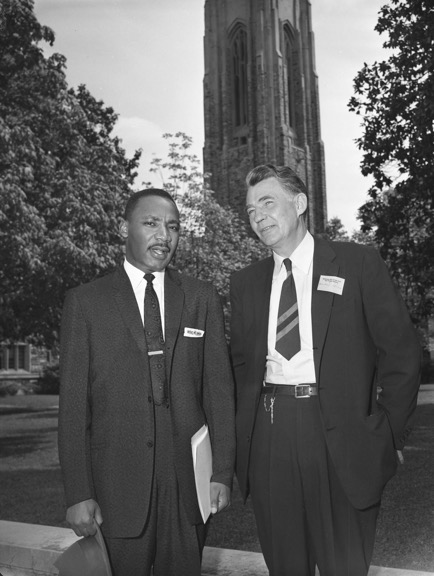
Howard Kester and Martin Luther King Jr.

The Journal of Southern Religion has published my article "A Misplaced Hope: Howard Kester, the Fellowship of Southern Churchmen, and the Failed Attempt to Mobilize White Moderate Protestants in Support of Desegregation, 1952-1957."
Martin Luther King Jr. and Howard Kester at 
the Conference on Christian Faith and Human  
Relations, Scarritt College, Nashville, April 25, 
1957. Photographer: Jack Gunter, courtesy 
Nashville Public Library, Special Collections.

If you would like a printable version then here you go.

In the article, I look at the failed attempt by some remarkable southern Christians in the 1950s to mobilize white moderate Protestants in support of desegregation. It is really my response as a church historian to this 'Trump moment' in the American church.

It is the by-product of the research I did into the life and work of Howard Kester for a chapter in the upcoming book Can I Get a Witness? Thirteen Peacemakers, Community-Builders, and Agitators for Faith and Justice.

Tuesday, June 12, 2018

Thoughts After Reading Mitch Landrieu’s In the Shadow of Statues: A White Southerner Confronts History


I have written a review of Mitch Landrieu's book over on the Project for Lived theology's web site. It is really my reflection how hard it is for even the supposedly most "woke" white people to really come to terms with the power and persistence of white supremacy.

Thursday, April 26, 2018

The Massive Resistance Museum and the Other Local People

Over spring break I went on a 2,000 mile road trip to Jackson, Mississippi to see the state’s new civil rights museum. As historian Jemar Tisby explained when the museum opened back in December, the philosophy behind the exhibits is influenced by John Dittmer’s 1994 book Local People: The Struggle for Civil Rights in Mississippi. The Mississippi Civil Rights Museum does not settle for expanding the pantheon of civil rights heroes (Martin Luther King, John Lewis etc) with new ones (Fannie Lou Hamer, Medgar Evers etc.). Instead, the museum presents an overwhelming array of names and photographs of the army of local people who:
  registered to vote,
  rode greyhound busses,
  boycotted businesses,
  prayed in churches,
  integrated schools,
  ate at lunch counters,
  and went to jail.

Overwhelming, at least, for those who prefer their history neat and contained and bounded. These exhibits, and the history they reveal, defy any individual’s encyclopedic knowledge. This is a good thing. As the museum’s advisors and designers no doubt intended, a visitor leaves with a sense of the massive, messy, movement of local people that over decades challenged the forces of white supremacy that enslaved, disenfranchised, and oppressed African Americans in Mississippi and America: a movement of local people that continues to the present and that you--a visitor to the museum--can choose to join.

White supremacy, of course, is not a disembodied force: it took white supremacists to make it work. It took hundreds of thousands of “local people” too--far more, in fact, than the local people demanding civil rights. This is a reality that the Mississippi Civil Rights Museum does not communicate as successfully. It does not, in my opinion, succeed in giving the visitor an equivalent sense of this massive, messy and continuing movement of local people.

Don’t misunderstand me, the museum does not sugarcoat or minimize the crimes of white supremacists:
  lynchings,
  bombings,
  assassinations,
  beatings,
  economic exploitation,
  school segregation.
But it only gestures toward the armies of local people behind these crimes using Klan robes, burnt crosses and the names and photographs of the usual villains (Sam Bowers, Cecil Price, Edgar Ray Killen, Ross Barnett).

The thousands of Mississippi’s schoolchildren passing through the museum really need to understand this other movement of local people.

To appreciate the forces preventing this, just engage in this thought experiment. Imagine the announcement of a new museum: The Mississippi Massive Resistance Museum. It is a museum that tells the long story of white supremacy and massive resistance stretching from the earliest days of European settlement to the present day. It presents the range of people who profited from white supremacy and the lengths regular people went to to maintain their race-based privilege. The museum helps visitors understand how white supremacy required tens of thousands of local people to support and maintain it.

Imagine, one display tells the story of the trial of Roy Bryant and his half-brother J.W. Milam--the self-confessed murderers of the young Emmett Till in 1955. Bryant and Milam’s photographs are there of course, just as they are in the civil rights museum; but in this imaginary Massive Resistance Museum, so too are the photographs and names of the white men on the grand jury who refused to indict them.
Another display contains the names and photographs of law enforcement officers known to have been in the Klan. A whole wall has the names and photographs of the directors of the state’s chapters of the Citizens’ Council. These lists of names are available in the state’s secret police files. Looking at the photographs of the directors of Jackson’s chapter, visitors will see the city’s white attorneys, civil servants, doctors, and business owners.

White children will see their grandparents.

You get the idea.

Can you imagine such a museum actually being built in Mississippi or any other state in the union?

I can’t.

I am afraid I can’t imagine this level of truth-telling:
the kind of truth-telling we need as a country so that we are not constantly surprised by the irruptions of hate and violence;
the kind of truth-telling we need as a country so that we are not blindsided by the unidentified but often felt influence of white supremacy in the lives of local people.
I can’t imagine it.
But then I couldn’t have imagined the opening of a national museum taking a hard look at the history of lynching either . . . and that happened today. So what do I know?

Thursday, April 5, 2018

Sermon on the Anniversary of MLK's Assassination

I delivered a sermon, "Prayer and Justice", at the community chapel service in Ashland University's Chapel on April 4 to mark the 50th anniversary of Martin Luther King's assassination.


I wove together the story of King's last year and the Poor People's Campaign with James 5:
"Listen! The wages of the laborers who mowed your fields, which you kept back by fraud, cry out, and the cries of the harvesters have reached the ears of the Lord of hosts. . . You have condemned and murdered the righteous one, who does not resist you."

But America chose not to listen​;
instead​,​ the majority--the friends of the world--chose to condemn King and, in so doing, were complicit in his murder.
In many ways, what we see today on our streets and in our government,
in the news and on our smartphones:
the unrest, the divisions, the racism,
the economic disparities between the haves and the have nots,
the violence, and the murder
--the fact that 50 years after King’s death we still need to remind ourselves that Black Lives Matter too--
in many ways, all of this is the consequence of our country’s condemnation of King and the rejection of his message.
-
For further reading:
Here are links to the the document and sermons I reference in the sermon: